Angel
Interview with the VampireAngels are a central figure in the vampire’s attempt to understand what he has become. They belong at once to religious doctrine, visionary imagery, and self-description: they suggest beings above ordinary human limits, yet they also carry the memory of rebellion, pride, hatred, and the Fall. Through them, the narrative refuses to make transcendence morally pure. The vampire’s condition can resemble angelic elevation, but it remains bound to blood, death, and the question of whether power can exist without damnation.
Angels and the Collapse of Human Certainty
The vampire’s first decisive transformation begins when he encounters Lestat, whose supernatural presence destroys his confidence in ordinary explanations. Before that meeting, he had treated possession as a name imposed on madness, especially by priests who might mistake violent mental disturbance for Satanic invasion. The appearance of a saint, by contrast, seemed to him even more difficult to accept, because it would require believing that an extraordinary vision had genuinely occurred among ordinary people. This resistance is described as egotism: a refusal to believe that anything exceptional could appear in the immediate world.
Lestat’s arrival annihilates that resistance. His gray eyes, inhuman hands, and extraordinary aura make the vampire feel reduced to nothing; the ego that had rejected the possibility of an extraordinary being is crushed. In that instant, his former gods—food, drink, security, and conformity—become cinders, while possibility opens before him. The supernatural thus enters the narrative through an experience structurally related to religious revelation, but the revealer is not a saint. The vampire is introduced to transcendence through a predator whose beauty and power make the old moral vocabulary seem inadequate.
The Vampire as Fallen Angel
The vampire later describes beings like himself as dark angels who are not confined to Hell but wander across the earth and its kingdoms. Lestat presents vampiric existence as a condition beyond ordinary human limits: vampires are immortal, take the rich and poor indiscriminately, and resemble God in their power over life and death. His argument turns divine action into a precedent for killing, replacing human moral distinctions with an image of cosmic likeness. The claim that evil is a point of view completes this inversion, making the vampire’s predation appear not as a violation of order but as participation in a darker order of creation.
Yet the angelic comparison is unstable because the vampire’s elevation is inseparable from appetite. Lestat’s rhetoric does not merely explain vampirism; it seduces the hesitant vampire into accepting violence as nature. He promises an end to pain and transforms killing into a feast that conscience cannot appreciate. The language of dark angels therefore conceals coercion as much as it expresses liberation. Angelic status becomes a justification offered by the powerful to the vulnerable, while the vampire’s own suffering remains evidence that immortality has not removed moral anguish.
Love, Pride, and the Meaning of Detachment
The angelic image becomes more complex when the vampire is questioned about Babette Freniere. He has spoken of detachment, but his conduct toward her contradicts any simple idea of emotional emptiness. He protects her, devises a religious charity ball to restore her social position after her brother’s death, and later visits her unseen simply to know that she is happy. Her happiness produces happiness in him. When asked whether this feeling is love, he does not deny the possibility; instead, he examines the relation between love and angelic detachment.
The vampire argues that angels can love God, experience pride associated with the Fall, and feel hatred. Their defining condition is not the absence of emotion but the union of emotion and will in a being that remains detached from ordinary human limitation. Babette is called an ideal human being and the object of a powerful, though not supreme, feeling. The exchange matters because it separates detachment from indifference. For the vampire, angelic feeling is intense precisely because it is not softened by ordinary human belonging. Love survives, but it becomes vast, selective, and dangerous rather than domestic or morally reassuring.
Angelic Images in Ruins and Art
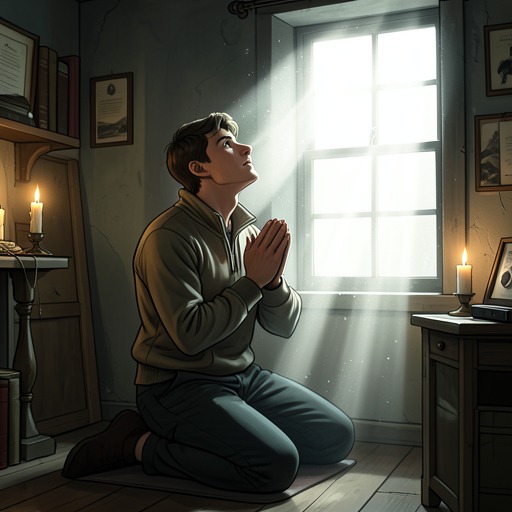
Angels also appear as visual figures in the vampire’s religious and artistic imagination. In the cathedral vision, sacred statues become lifeless forms, and the church turns into a cemetery of effigies, empty hands, frozen folds, and stone angels. The vampire sees himself as the only conscious supernatural being beneath the roof, while the saints and the cathedral crumble around him. A procession of pale vampires then advances through the ruins, carrying the remains of Lestat, and the scene culminates in an image of the vampire’s mortal brother replacing those remains. The angelic and religious setting does not provide consolation; it stages loneliness, guilt, and the collapse of inherited meaning.
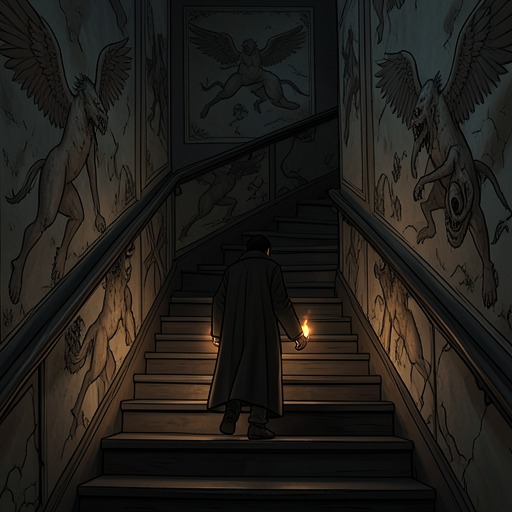
A related imagery governs the underground theater in Paris. The walls display monumental scenes of death and damnation, including the Triumph of Death and the Fall of the Angels. Angels are shown being driven from celestial heights into chaos among feasting monsters, while skeletons, corpses, demons, and instruments of pain turn the theater into a cathedral of death. The art makes visible the narrative’s central contradiction: beauty and horror are not opposites but adjoining forms. Angelic descent becomes an allegory for the vampire’s own movement from human life into a supernatural existence that retains splendor while exposing him to appetite, guilt, and ruin.
Angelic Language and Moral Consequence
The angelic vocabulary never finally resolves the vampire’s moral conflict. It can explain his grandeur, but it cannot erase the dead. Bodies remain to be hidden or burned: the murdered mother and daughter lie in an unused kitchen building, their corpses fouled, insect-covered, and surrounded by the stench of a graveyard; later, Lestat’s transformed remains are wrapped in a sheet, covered with chrysanthemums, and carried into the waters of Bayou St. Jean. These acts of disposal contrast sharply with the elevated language of dark angels. The supernatural body may appear sublime, but death leaves material residue that must be confronted.
The same conflict governs the vampire’s journey through Eastern Europe. He and Claudia seek ancient knowledge and the origins of their kind, reading accounts that describe vampires being burned, staked through the heart, and decapitated. What they find are mostly mindless corpses: creatures with rotted clothing, grave dirt on their fingers, and empty eyes reflecting the moon. Their condition exposes the limits of the angelic ideal. Immortality does not automatically produce consciousness, wisdom, or spiritual elevation. The vampire fears that Lestat, whom they believed destroyed, may have been the only other creature to escape this mindlessness, and his despair eventually turns into a longing for Lestat’s return.
The figure of the angel therefore remains deliberately divided. Angels name revelation, beauty, and a life beyond human measure, but they also recall pride, expulsion, and the possibility that transcendence is only another form of alienation. In the vampire’s world, to become more than human is not to become morally superior. It is to stand among ruins, able to love and hate with overwhelming force, while remaining answerable to blood, memory, and the consequences of killing.